Turnkey Solutions
Waste A–Z
Sectors
Project development
Engineering & Delivery
Operations & Lifecycle
Commercial & Investment Models
Warp Gasification
team@univastum.com
Knowledge Base
Chief Technology Officer
Peter Kalenuk
Industrial Waste-to-Steam
Integrated Waste-to-Steam facility for industrial client
Spain
Municipal Waste-to-Electricity
Modular Waste-to-Energy facility for municipal solid waste
Romania
investors@univastum.com
Chief Investment Officer
Eben Klynsmith
Our Approach
Work With Us
Insights & News
Press Kit
mt@univastum.com
Chief Marketing & Communications Officer
Matthew Tucker
About Univastum
Leadership & Governance
Careers
Sustainability
Municipal Waste-to-Energy Solutions
Modular and Distributed Waste-to-Energy Projects Based on WARP Gasification Technology
WARP based Waste-to-Energy projects are designed to convert municipal waste into electricity, heat and cooling while reducing the volume of waste sent to landfill.
Feedstock options include unsorted municipal solid waste (MSW), subject to subsequent sorting and preparation, as well as pre-processed RDF and SRF.
Feedstock options include unsorted municipal solid waste (MSW), subject to subsequent sorting and preparation, as well as pre-processed RDF and SRF.
One standard WARP gasification module is designed to process up to 80,000 tonnes of incoming MSW per year or up to 40,000 tonnes of prepared RDF/SRF per year, delivering 6–8 MW of net electrical output.
The modular architecture allows projects to scale from a single WARP module serving a small city to multiple modules serving larger municipalities. For metropolitan areas, a Distributed Waste-to-Energy model can be implemented, with several facilities located across the urban area, each serving its respective waste collection zone.
Univastum delivers projects through equipment supply and turnkey delivery arrangements and also participates in long-term projects under BOO, BOOT and PPP models, including project development, structuring, financing and operation.
Univastum delivers projects through equipment supply and turnkey delivery arrangements and also participates in long-term projects under BOO, BOOT and PPP models, including project development, structuring, financing and operation.
Modular Solutions for Cities of Different Sizes
Waste-to-Energy project capacity is determined by the available waste volume and configured using standard WARP gasification modules. The table below illustrates project scalability from one to six modules.
MSW and RDF/SRF represent alternative feedstock streams and should not be added together.
When processing incoming MSW, the project includes the necessary waste sorting and preparation system. When using prepared RDF/SRF, the extent of additional preparation depends on the fuel characteristics.
When processing incoming MSW, the project includes the necessary waste sorting and preparation system. When using prepared RDF/SRF, the extent of additional preparation depends on the fuel characteristics.
The WARP module retains its standard design, while the waste preparation system is adapted to local waste characteristics.
Solutions for Smaller Cities and Intermunicipal Projects
For smaller cities, a project may comprise a single WARP module.
Where the waste volume generated by one municipality is insufficient, a single Waste-to-Energy facility can serve several neighbouring municipalities, combining their waste streams within a shared waste processing and energy generation system.
Additional modules can be installed to increase facility capacity as required.
Distributed Waste-to-Energy for Metropolitan Areas
For large cities and metropolitan areas, a distributed model can be implemented instead of a single centralised Waste-to-Energy facility.
Several Waste-to-Energy facilities are located across the metropolitan area, each serving a designated waste collection zone. Each facility incorporates one or more WARP modules, depending on the available waste stream.
Several Waste-to-Energy facilities are located across the metropolitan area, each serving a designated waste collection zone. Each facility incorporates one or more WARP modules, depending on the available waste stream.
Diagram 1 — Centralised vs Distributed Waste-to-Energy
A schematic map of a metropolitan area divided into several waste collection zones, with a separate WARP® Waste-to-Energy facility located within each zone.
Illustrate the movement of waste to the respective facilities and the delivery of generated electricity to the grid or local consumers.
Illustrate the movement of waste to the respective facilities and the delivery of generated electricity to the grid or local consumers.
- Option A
One large plant
All waste to one plant on the outskirtsAverage distance: 25-40 km - Option B
Distributed plants
Waste processed close to the sourceAverage distance: 5-10 km
Sites are selected based on waste logistics, existing infrastructure, grid connection opportunities and the location of potential heat consumers. Distributed Waste-to-Energy can reduce waste transportation distances, associated transportation costs and logistics-related emissions.
Capacity can be deployed in phases across individual districts in line with available waste volumes and the development of urban infrastructure.
Capacity can be deployed in phases across individual districts in line with available waste volumes and the development of urban infrastructure.
From Municipal Waste to Electricity
Diagram 1 — Municipal Waste-to-Energy Process
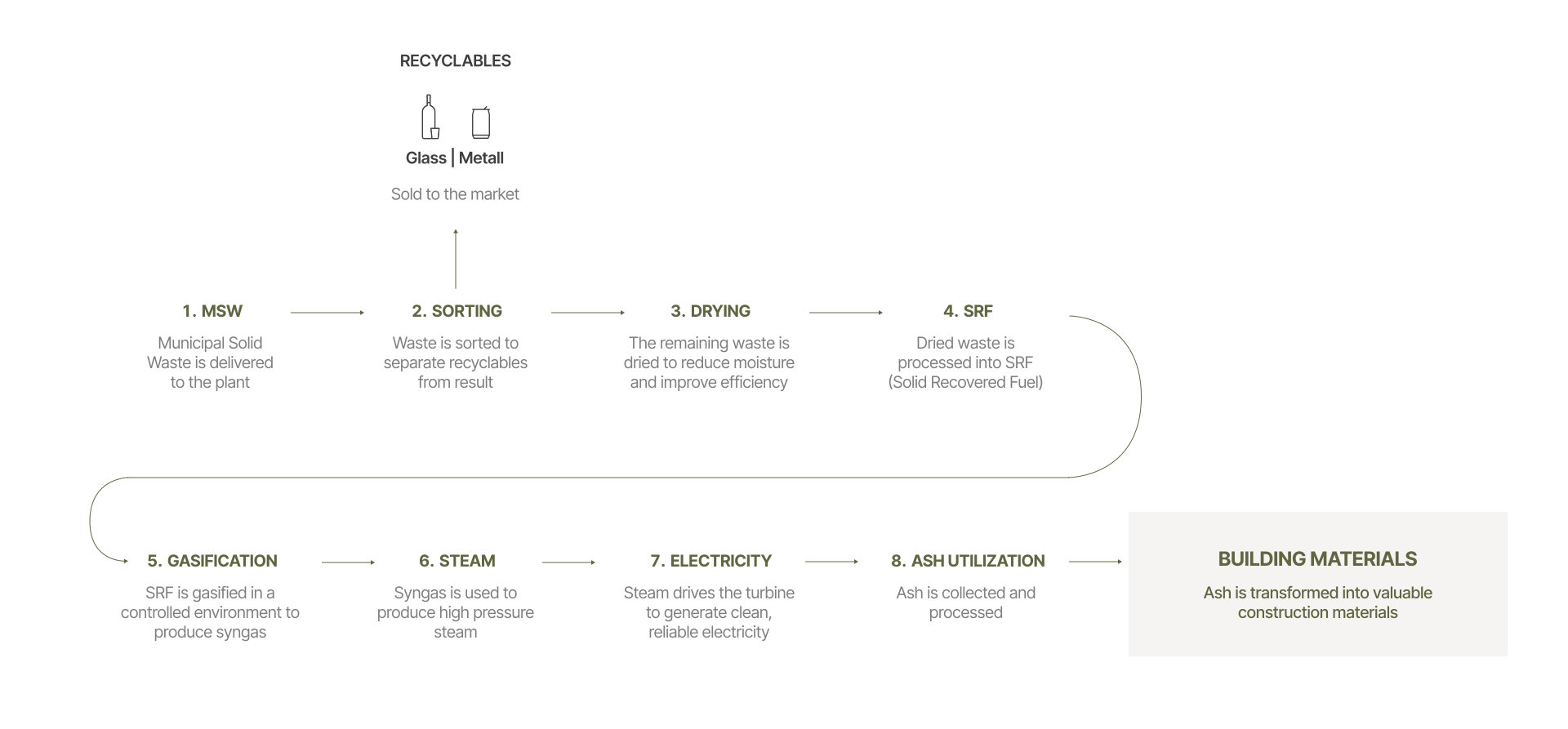
Process flow:
MSW Reception → Sorting & Preparation → Prepared Fuel → WARP Gasification → Syngas → Energy Generation → Electricity & Heat
Separately illustrate the use of internally recovered heat for waste drying.
When processing unsorted MSW, the waste preparation system includes sorting, recovery of recyclable materials, shredding, drying and homogenisation.
When processing unsorted MSW, the waste preparation system includes sorting, recovery of recyclable materials, shredding, drying and homogenisation.
Waste drying uses heat recovered within the Waste-to-Energy facility and does not require external energy sources.
The prepared fuel is fed into a standard WARP® module, where it is converted into syngas for subsequent electricity generation and, depending on the project configuration, heat production.
Recyclable Materials and Landfill Minimisation
Univastum Waste-to-Energy facilities are designed for integrated municipal waste processing, producing energy, recovered materials and construction products.
During waste preparation, metals, stones and glass are separated from the incoming waste. The remaining combustible fraction is directed to WARP gasification.
Ash generated during the WARP gasification process has been classified as Class IV under the relevant national waste classification system. Subject to applicable regulatory requirements, it can be used for road construction and backfilling, paving block production and other construction materials.
Univastum Waste-to-Energy facilities incorporate on-site production of construction materials using ash generated by the gasification process.
The facilities are therefore designed to produce three main categories of marketable products:
- EnergyElectricity and heat
- Recovered materialsMetals and other materials recovered for further processing and sale
- Construction materialsPaving blocks and other ash-based products
This approach aims to maximise the utilisation of incoming waste, convert residual streams into marketable products and minimise landfill disposal.
Energy Independence and Predictable Energy Costs
Univastum Waste-to-Energy projects enable municipalities to generate electricity and heat from locally available waste, reducing dependence on external energy suppliers and exposure to fluctuations in energy markets.
A stable local waste stream provides a basis for long-term energy supply planning and greater predictability of energy production costs.
Generated electricity can be supplied to the grid or delivered directly to local consumers. Where sufficient demand exists, projects can also provide heat for municipal infrastructure and industrial facilities.
Standardisation and Project Delivery Timeline
The standardised modular WARP architecture enables the use of repeatable engineering solutions, allows facility capacity to be matched to available waste volumes and supports phased project expansion.
This standardisation enables Waste-to-Energy project delivery within 18–24 months.
Municipal Waste-to-Energy Project Economics
Waste-to-Energy projects offer several potential revenue streams while also providing municipalities with long-term economic and infrastructure benefits.
Main Project Revenue Streams
- Tipping fees / gate feeslong-term fees for the acceptance and processing of municipal waste
- Electricity saleselectricity supplied to the grid or directly to consumers under the relevant commercial agreements
- Heat salesan additional revenue stream where municipal or industrial heat consumers are available
- Recovered material salesrevenue from metals and other materials recovered during waste preparation
- Construction material salesrevenue from products manufactured on-site using ash generated by the gasification process
- Carbon creditsa potential additional revenue stream, subject to verified emissions reductions and compliance with the requirements of applicable carbon credit certification mechanisms
Combining waste processing revenues, energy generation and the sale of marketable products creates multiple potential revenue streams within a single infrastructure project.
The specific economic model is developed individually, taking into account project characteristics, local market conditions and the selected commercial structure.
The specific economic model is developed individually, taking into account project characteristics, local market conditions and the selected commercial structure.
Economic and Infrastructure Benefits for Municipalities
Beyond the financial performance of the Waste-to-Energy facility itself, projects offer additional opportunities to reduce municipal expenditure and support urban infrastructure development.
Reduced Waste Transportation Costs
Distributed Waste-to-Energy enables processing facilities to be located closer to waste generation areas, reducing transportation distances to remote landfills.
This reduces expenditure on fuel, waste collection, vehicle maintenance and transportation infrastructure. In certain projects, estimated savings from waste transportation distance reduction can reach millions of euros every year.
This reduces expenditure on fuel, waste collection, vehicle maintenance and transportation infrastructure. In certain projects, estimated savings from waste transportation distance reduction can reach millions of euros every year.
Reduced Landfill Requirements and Preservation of Land Resources
Converting municipal waste into energy reduces the volume of waste requiring landfill disposal and decreases the need to develop new landfills or expand existing ones.
Land that would otherwise be required for waste disposal can instead be allocated to residential and commercial development, industrial activities and public infrastructure.
This enables municipalities to reduce long-term waste management expenditure while preserving land for economic development.
Land that would otherwise be required for waste disposal can instead be allocated to residential and commercial development, industrial activities and public infrastructure.
This enables municipalities to reduce long-term waste management expenditure while preserving land for economic development.
Environmental Benefits and Urban Quality of Life
Reducing landfill disposal can help decrease associated greenhouse gas emissions, risks of soil and water contamination, unpleasant odours and other adverse environmental impacts.
Subject to compliance with applicable environmental requirements, this contributes to improved environmental conditions, reduced potential public health risks and a better urban environment.
Modern waste management infrastructure, reduced dependence on landfills and more efficient use of urban land also create opportunities for further economic and infrastructure development.
Integration with Existing Urban Infrastructure
WARP Waste-to-Energy projects can be developed on new sites or integrated into existing waste management infrastructure.
Brownfield projects may utilise existing:
This approach enables existing assets and infrastructure to be utilised rather than developing the entire process infrastructure from scratch.
Brownfield projects may utilise existing:
- Waste transfer stations
- Sorting and Material Recovery Facilities (MRFs)
- RDF/SRF production lines
- Waste management sites
- Industrial sites and existing utility connections
This approach enables existing assets and infrastructure to be utilised rather than developing the entire process infrastructure from scratch.
For Project Developers and Infrastructure Investors
Univastum combines its standardised WARP technology platform and modular architecture with participation at various stages of Waste-to-Energy project development and delivery.
This approach reduces project complexity, enables phased capacity development and establishes the technical and commercial foundation required to attract project financing.
This approach reduces project complexity, enables phased capacity development and establishes the technical and commercial foundation required to attract project financing.
Key Advantages
Standardised Technology Platform
Repeatable WARP engineering solutions reduce the need for project-specific engineering and facilitate project scaling.
Phased Capital Deployment
The modular architecture allows initial capacity and capital expenditure to be aligned with confirmed waste volumes, with the flexibility to expand capacity as the project develops.
Diversified Revenue Structure
Revenue can be generated from waste processing, electricity sales, heat sales and marketable products. Each revenue stream requires separate commercial validation.
Integration with Existing Infrastructure
Utilising existing infrastructure can reduce the scope of new construction and the associated capital expenditure.
Project Preparation for Due Diligence
Univastum supports the preparation of comprehensive technical and commercial documentation for project due diligence, including feedstock specifications, mass and energy balances, projected equipment availability, waste supply and energy offtake agreements, EPC scope, O&M/LTSA terms and permitting documentation.
Participation Throughout the Project Lifecycle
Univastum can participate at various project stages, from preliminary engineering assessments and FEED to equipment supply, EPC integration, commissioning and long-term maintenance.
Depending on the project structure, Univastum and its partners may also participate in project financing arrangements.
Depending on the project structure, Univastum and its partners may also participate in project financing arrangements.
Delivery Models, Project Development and Financing
Univastum develops and delivers municipal Waste-to-Energy projects under various commercial models:
Equipment Supply & Turnkey Delivery
BOO — Build, Own, Operate
BOOT — Build, Own, Operate, Transfer
PPP — Public-Private Partnership
The delivery model is determined individually based on municipal requirements, the financing structure and project-specific conditions.
From Preliminary Concept to Commercial Operation
Diagram 3 — Project Development & Delivery
Pre-Feasibility
Initial assessment of project potential, site screening and high-level evaluation
Waste study
Detailed waste characterization, quantification and logistics analysis
Pre-Feed
Process design, mass & energy balance, layout, CAPEX/OPEX and project economics
Financing
Financing structuring, funding plan, risk allocation and investment close
EPC
Engineering, procurement, construction and commissioning
Operation
Reliable operations, performance optimization and long-term value
Project development and delivery stages:
Preliminary Assessment → Feasibility Study → FEED → Financial Close → Project Execution → Commissioning → Commercial Operation → O&M / LTSA.
During the preliminary assessment, the waste stream, required number of WARP modules, waste preparation system, energy generation configuration, principal site requirements and preliminary project economics are established.
Project Structuring and Financing
For long-term BOO, BOOT and PPP projects, Univastum may work with its partners on project structuring and the arrangement of equity and debt financing.
Depending on the project location and structure, potential financing sources may include commercial banks, export credit agencies (ECAs), institutional investors and other capital providers.
Depending on the project location and structure, potential financing sources may include commercial banks, export credit agencies (ECAs), institutional investors and other capital providers.
Information Required for a Preliminary Project Assessment
The following information is required for an initial assessment:
The outcome is a preliminary technical and commercial concept that provides a basis for deciding whether to proceed to the next stage of project development.
- MSW volume, tonnes per day and tonnes per year
- Waste composition, moisture content and key characteristics
- Existing waste sorting and preparation infrastructure
- Availability and characteristics of RDF/SRF
- Tipping fee / gate fee
- Proposed site and existing infrastructure
- Electricity grid connection conditions
- Potential heat consumers
- Current project development stage
- Financing status and proposed financing structure
The outcome is a preliminary technical and commercial concept that provides a basis for deciding whether to proceed to the next stage of project development.