Turnkey Solutions
Waste A–Z
Sectors
Project development
Engineering & Delivery
Operations & Lifecycle
Commercial & Investment Models
Warp Gasification
team@univastum.com
Knowledge Base
Chief Technology Officer
Peter Kalenuk
Industrial Waste-to-Steam
Integrated Waste-to-Steam facility for industrial client
Spain
Municipal Waste-to-Electricity
Modular Waste-to-Energy facility for municipal solid waste
Romania
investors@univastum.com
Chief Investment Officer
Eben Klynsmith
Our Approach
Work With Us
Insights & News
Press Kit
mt@univastum.com
Chief Marketing & Communications Officer
Matthew Tucker
About Univastum
Leadership & Governance
Careers
Sustainability
How WARP Gasification Works
From Prepared Fuel to Conditioned Syngas
Univastum's proprietary gasification technology — WARP (Waste Advanced Reforming Process) — is designed to convert prepared carbon-containing feedstock into syngas.
WARP combines two principal technological processes: gasification of prepared feedstock and subsequent preparation of the syngas for use in electricity generation, industrial steam production, process heat applications, and partial substitution of natural gas in compatible equipment.
WARP combines two principal technological processes: gasification of prepared feedstock and subsequent preparation of the syngas for use in electricity generation, industrial steam production, process heat applications, and partial substitution of natural gas in compatible equipment.
WARP Technology Process
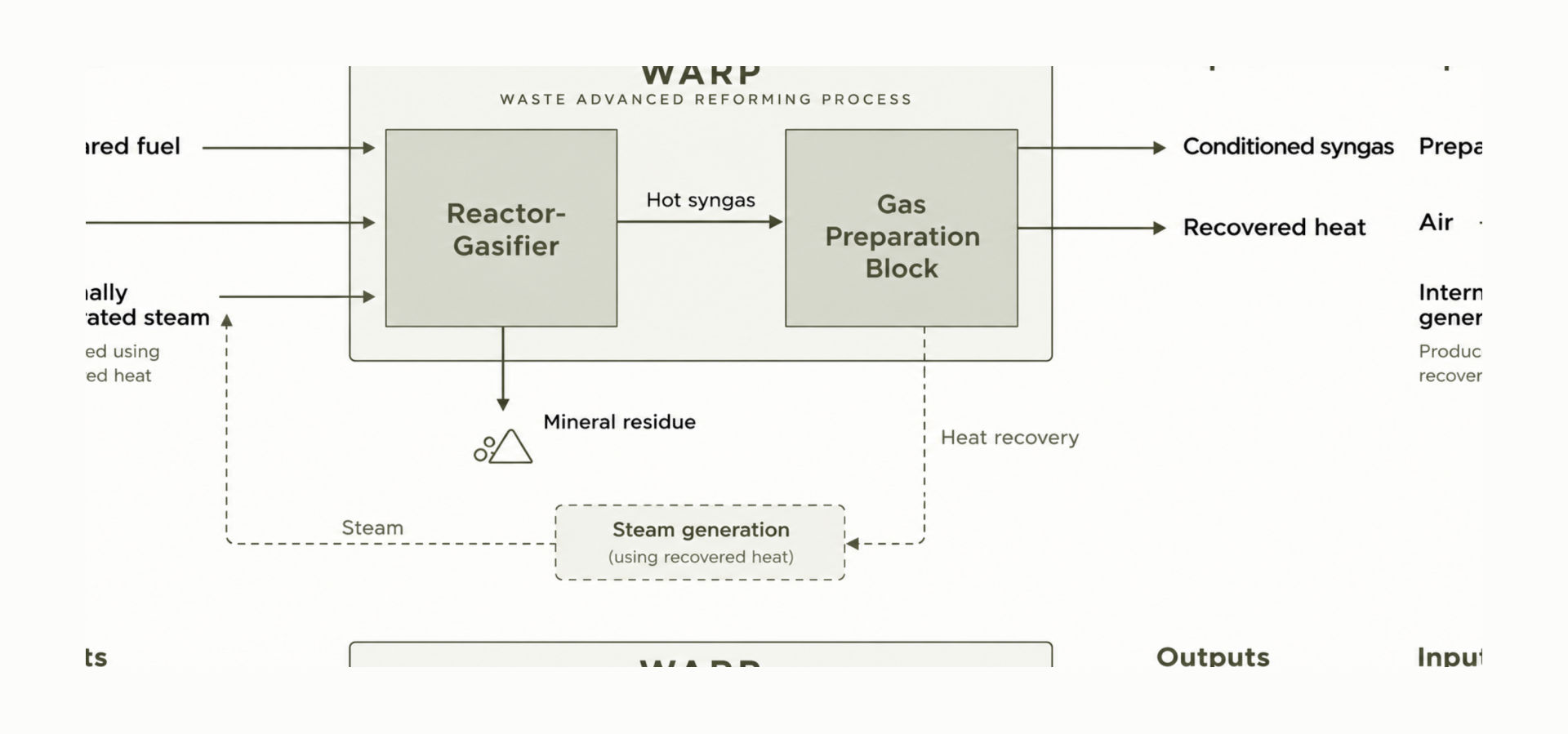
WARP consists of two main technological blocks:
Reactor-Gasifier
the core element of WARP technology, where prepared fuel is converted into hot syngas and mineral residue
Gas Preparation Block
provides cooling and preparation of the syngas to the parameters required for its further use
Together, these two blocks form the complete WARP technological process.
Diagram 1 — WARP Technology Block
Reactor-Gasifier
Gasification is carried out through controlled thermochemical conversion of the fuel under oxygen-deficient conditions. The required temperature regime is maintained by partial oxidation of the fuel with controlled supply of air and steam.
When prepared fuel meeting WARP technical requirements is used, the gasification process does not require a supply of additional fuel.
When prepared fuel meeting WARP technical requirements is used, the gasification process does not require a supply of additional fuel.
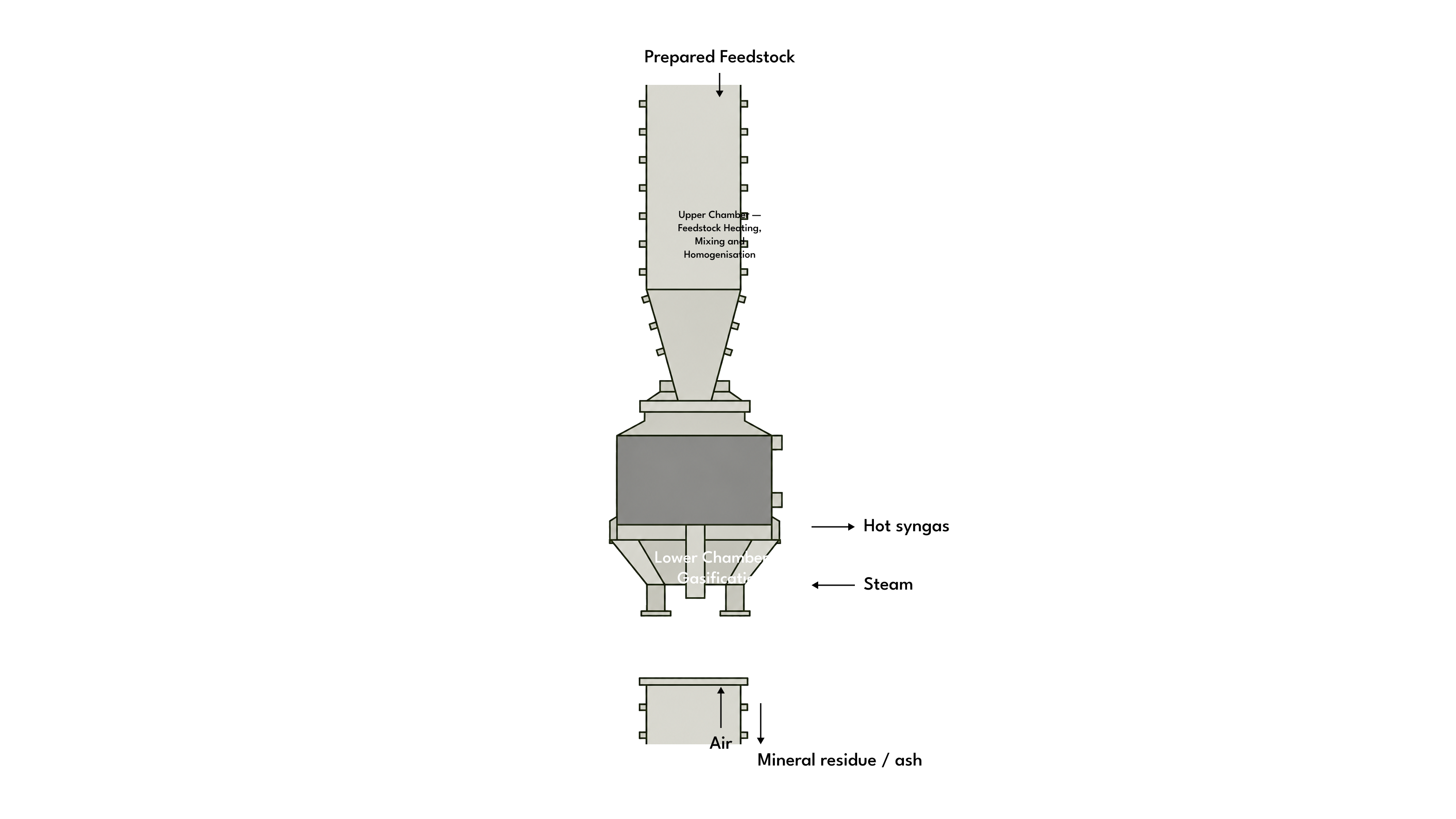
The WARP reactor-gasifier consists of two main chambers:
Upper Chamber
feedstock preparation: heating, mixing and homogenisation
Lower Chamber
gasification: the main thermochemical processes converting the fuel into syngas.
feedstock preparation: heating, mixing and homogenisation
Lower Chamber
gasification: the main thermochemical processes converting the fuel into syngas.
Diagram 2 — Simplified WARP Reactor-Gasifier
Gas Preparation Block
The Gas Preparation Block provides syngas with the characteristics required for its further use in energy equipment, including steam boilers and gas turbines.
The Gas Preparation Block performs three main functions:
The Gas Preparation Block performs three main functions:
- cooling of hot syngas
- removal of solid particles entrained in the gas flow
- removal of undesirable gaseous components and impurities, including sulphur-containing, chlorine-containing, fluorine-containing and other compounds that may affect the subsequent energy use of the syngas
Mineral Residue
The gasification process produces a solid mineral residue consisting predominantly of inorganic components of the original fuel.
Residual carbon content is below 1%
The mineral residue may potentially be used in the production of construction materials, subject to compliance of its characteristics with applicable technical and environmental requirements.
WARP gasification Capacity and Operating Mode
WARP modules are designed for continuous 24/7 operation, with scheduled shutdowns for maintenance.
One standard WARP module has an adjustable throughput of 3.6–5.4 tonnes of prepared fuel per hour.
The automated control system regulates fuel supply and monitors the main gasification process parameters, ensuring stable equipment operation throughout the specified operating range.
The modular WARP architecture allows several gasification modules to be combined into a single technological system, enabling total capacity to be scaled in accordance with the requirements of a specific project.
Feedstock
WARP technology is designed for gasification of various types of prepared carbon-containing fuels, including controlled mixtures of several feedstocks.
The following fuels may be used:
Feedstock pre-treatment provides the physical characteristics required for stable continuous feeding
and gasification in the WARP reactor - gasifier.
The following fuels may be used:
- prepared fuel derived from municipal solid waste (MSW)
- RDF and SRF
- prepared combustible industrial waste
- tires
- biomass
Feedstock pre-treatment provides the physical characteristics required for stable continuous feeding
and gasification in the WARP reactor - gasifier.