Turnkey Solutions
Waste A–Z
Sectors
Project development
Engineering & Delivery
Operations & Lifecycle
Commercial & Investment Models
Warp Gasification
team@univastum.com
Knowledge Base
Chief Technology Officer
Peter Kalenuk
Industrial Waste-to-Steam
Integrated Waste-to-Steam facility for industrial client
Spain
Municipal Waste-to-Electricity
Modular Waste-to-Energy facility for municipal solid waste
Romania
investors@univastum.com
Chief Investment Officer
Eben Klynsmith
Our Approach
Work With Us
Insights & News
Press Kit
mt@univastum.com
Chief Marketing & Communications Officer
Matthew Tucker
About Univastum
Leadership & Governance
Careers
Sustainability
Turnkey Waste-to-Energy Plants
From concept development and financing arrangements to commissioning and operations management.
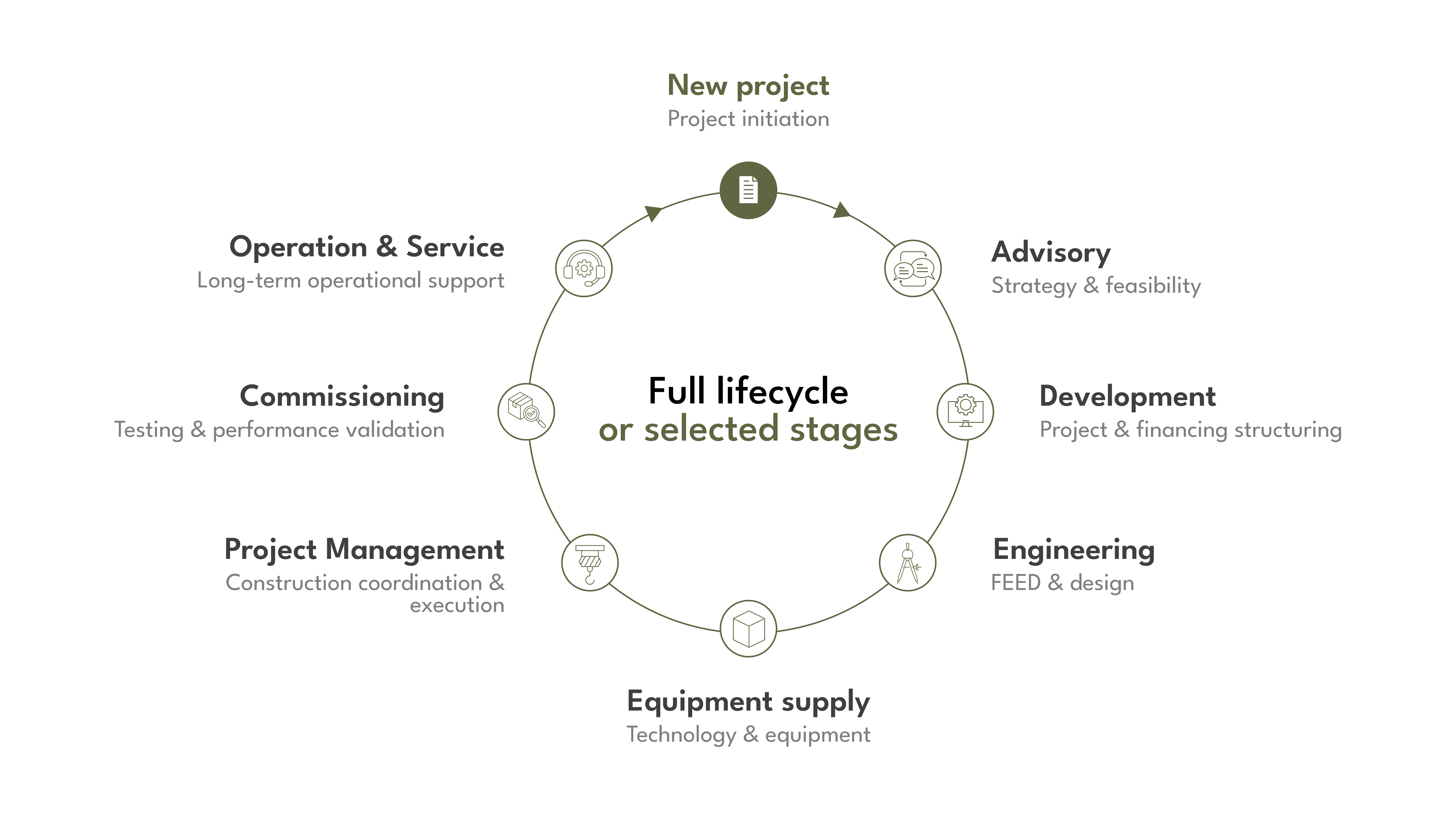
Univastum develops and delivers Waste-to-Energy plants based on WARP gasification technology. We manage projects from concept development and financing arrangements through engineering, equipment supply and construction management to commissioning and operations management.
Univastum’s involvement may also include technical support, training for the customer’s personnel and support for carbon credit issuance. Plant configuration, scope of work and the responsibilities of each party are defined for each project.
Univastum’s involvement may also include technical support, training for the customer’s personnel and support for carbon credit issuance. Plant configuration, scope of work and the responsibilities of each party are defined for each project.
Project Development and Financing
The initial assessment covers feedstock, the site, energy demand, utility connections and permitting requirements.
Depending on the project stage, our scope may include:
Depending on the project stage, our scope may include:
- technical concept development and feasibility studies
- preparation of material and energy balances, capital and operating cost estimates, and financial modelling
- definition of the ownership structure and commercial model
- development of waste or fuel supply and energy offtake terms
- preparation of technical and commercial materials for investors and lenders
- coordination of project due diligence and financing arrangements
The plant may be owned by the customer or a project company. Project structuring considers BOO and BOOT models, public–private partnership arrangements and Energy-as-a-Service. Funding sources, the roles of the parties and investment commitments are defined for each project.
Plant Scope
Univastum integrates process equipment, energy systems and infrastructure into a complete plant.
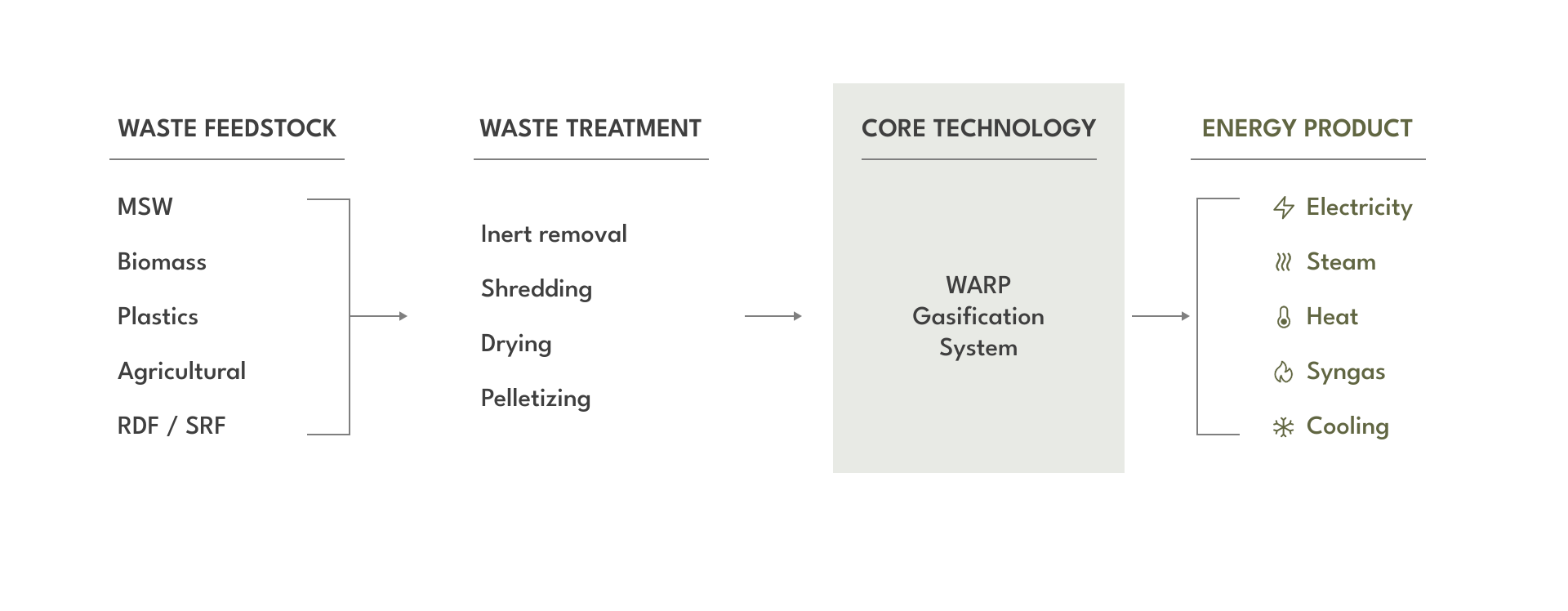
Depending on project requirements, the plant may include:
- waste preparation, pellet production, fuel storage and feeding systems
- the WARP waste gasification system
- equipment for producing electricity, industrial steam, heat or cooling
- electrical equipment, automation and control systems
- auxiliary systems
- environmental control and monitoring systems
- equipment for handling ash and process residues
- buildings, structures and site infrastructure
The project defines the scope of supply, equipment and works to be provided by the customer, and external utility connection requirements. All systems are matched in terms of capacity and operating conditions.
Feedstock and Fuel Preparation
Gasification feedstocks may include pellets produced from municipal solid waste (MSW), as well as RDF, SRF and other suitable industrial or agricultural materials. Fuel suitability is assessed based on composition, calorific value, moisture content, ash content and contaminants.
Where required, the plant includes a waste preparation and pellet production line. If the customer or an external supplier provides fuel that meets the agreed specification, a separate preparation line may not be necessary.
Where required, the plant includes a waste preparation and pellet production line. If the customer or an external supplier provides fuel that meets the agreed specification, a separate preparation line may not be necessary.
WARP Gasification and Energy Products
The WARP system converts prepared fuel into syngas. Depending on its configuration, the plant can produce:
Energy equipment is selected and sized to match the customer’s requirements, intended energy use and offtake arrangements.
- electricity
- industrial steam
- heat
- cooling
- syngas for partial substitution of natural gas in technically compatible industrial processes
Energy equipment is selected and sized to match the customer’s requirements, intended energy use and offtake arrangements.
Modular Configuration and Expansion
The number of standard WARP gasification modules is determined by the required processing capacity, prepared fuel characteristics and operating profile. Waste preparation equipment, energy equipment and auxiliary systems are sized for the overall plant capacity.
For phased development, the design allows for additional modules and infrastructure expansion. Opportunities to increase capacity are assessed against available site area, resources and the operation of existing units.
For phased development, the design allows for additional modules and infrastructure expansion. Opportunities to increase capacity are assessed against available site area, resources and the operation of existing units.
Environmental Requirements and Residue Management
The project provides for emissions monitoring and the management of water, ash and process residues in accordance with applicable environmental requirements. Where mineral residues are confirmed to be suitable, the plant may include equipment for manufacturing construction materials.
Engineering, Construction and Project Management
Univastum coordinates engineering, equipment supply, construction and installation, ensuring plant integration and readiness for commissioning. Qualified local engineering and construction partners are engaged to carry out the works. The scope of work and each party’s responsibilities are defined in the contracts.
Technology Performance Guarantees and Insurance
Technology Performance Insurance (TPI) may be incorporated into Univastum projects to support agreed plant performance guarantees. Coverage is structured around project-specific parameters, including electricity output, syngas production volume and quality, and energy conversion efficiency.
The insurance structure may include two components:
The insurance structure may include two components:
Startup & Repair
funding for technical measures covered by the policy to support the achievement of agreed performance parameters during commissioning and start-up
Long-Term Performance
financial protection linked to insured performance parameters during commercial operation
TPI may be combined with construction and erection insurance, equipment insurance and business interruption insurance within a coordinated project insurance programme.
Commissioning, Testing and Handover
Univastum coordinates plant commissioning and start-up, testing to confirm agreed performance parameters, and handover for operation.
Operations Management and Long-Term Support
Following commissioning, Univastum can take responsibility for plant operations, work alongside a local operating team or provide training and support for the customer’s personnel where the customer operates the plant independently.
The scope may include plant operation and performance monitoring, maintenance, diagnostics, optimisation of operating conditions, shutdown planning and spare parts supply. Operations and maintenance (O&M) arrangements and long-term service agreements (LTSAs) may be agreed during project development.
The scope may include plant operation and performance monitoring, maintenance, diagnostics, optimisation of operating conditions, shutdown planning and spare parts supply. Operations and maintenance (O&M) arrangements and long-term service agreements (LTSAs) may be agreed during project development.
Carbon Certification and Credit Issuance
Univastum assesses the potential for a project to generate carbon credits and supports the preparation of project documentation, monitoring, independent validation and verification, project registration and credit issuance applications. Registration and issuance are subject to approval under the selected carbon programme. The agreed scope may include an assessment of potential revenue and coordination of sales of issued credits through specialist carbon market participants.
Starting a Project
An initial assessment requires information on feedstock volumes and composition, energy requirements, the site, infrastructure and the preferred ownership and operating model. Based on this information, Univastum develops an initial concept and defines the steps towards project financing and implementation.